The meat supply chain is the most virtuous in terms of waste compared to other food chains. : FAO (United Nations Food and Agriculture Organisation) estimated that about 1,3 billion tonnes of potentially-available food for consumption is lost or thrown during the various phases of the food chain, from the cultivation of agricultural products to the leftovers of food already cooked. The wasted quantities are very different and depend strictly on the territorial context, from cultural aspects and from the availability of efficient technologies throughout the chain.
The regenerative and circular economy of the beef supply chain
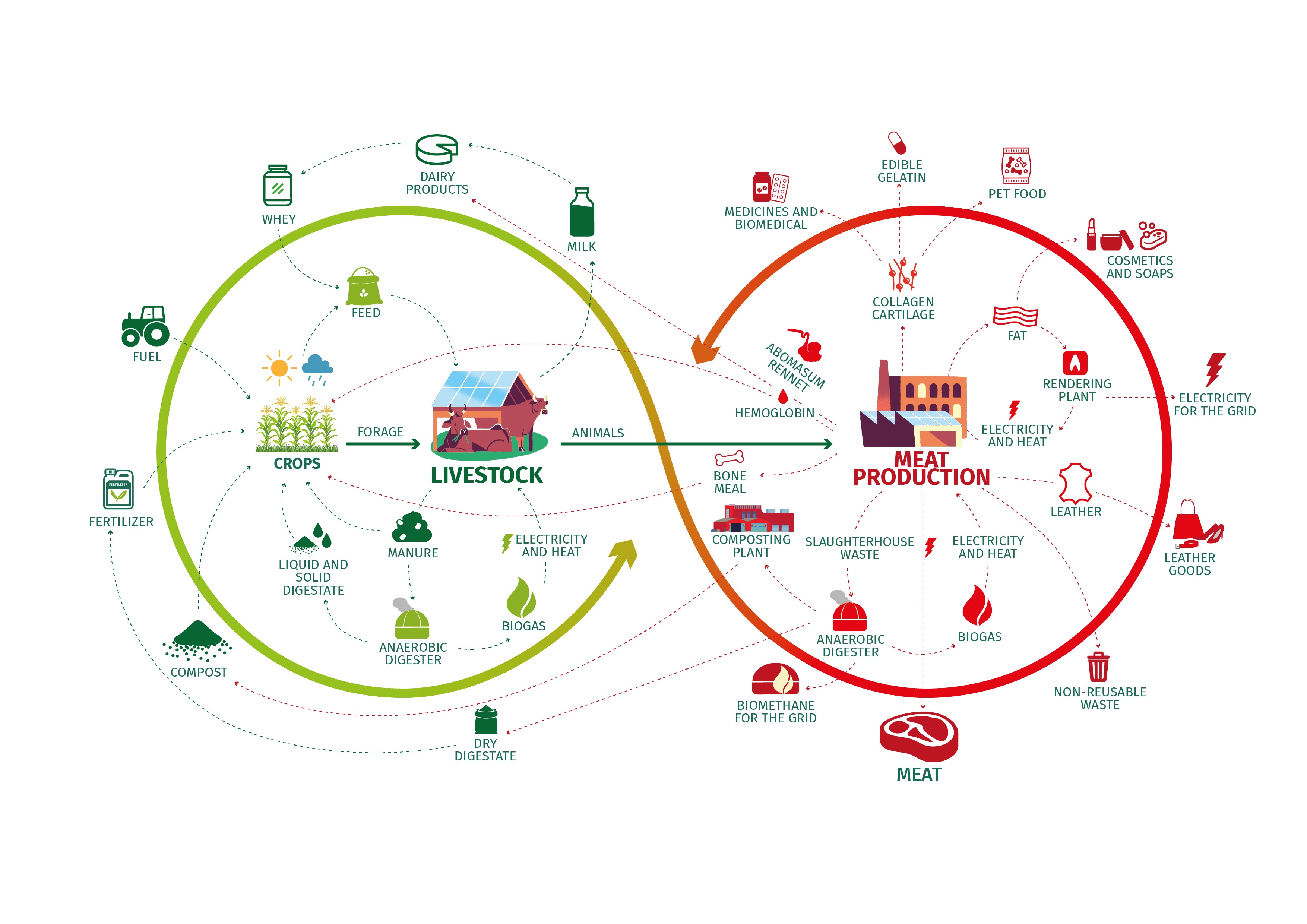
The meat supply chain offers significant opportunities for resource valorization throughout all phases of the production cycle, allowing waste to be minimized through the reuse and transformation of by-products into new materials or value-added products.
When describing the dynamics associated with food waste, it is good to make a basic distinction between two fundamental concepts, “food losses (waste)” and “food waste (waste)”:
• waste is made up of the mass of edible food that is “lost” within the production chain, that is, during the phases of agricultural production, handling and storage, processing and packaging of food;
• food waste, on the other hand, represents the quantity of food that is not eaten after being placed on the market, that is, during the phases of distribution and domestic consumption.
Energy, efficiency and valorization of by-products
For more than 25 years, INALCA has been investing in the development of innovative processes, technologies and solutions aimed at promoting an increasingly efficient use of resources and maximizing the value of the raw material along the entire production chain. Over time, this approach has helped strengthen the circularity of the Group’s business model, promoting material recovery and reducing waste. The meat supply chain offers significant opportunities for resource recovery and valorization, allowing for the use of different material applications that would otherwise be used in uses with lower added value. For this reason, INALCA has been developing and promoting recovery channels in various sectors for years, including food, pharmaceuticals, agriculture, energy, and animal nutrition.
Technological innovation plays an important role. Some components of the raw material, while suitable for recovery and valorization, require advanced transformation processes to fully express their potential. The evolution of biotechnological technologies and industrial processes opens up new opportunities to further increase resource recovery and foster the use of materials previously intended for lower-value applications.
With this in mind, a plant dedicated to the processing of fats and bones resulting from meat slaughtering and processing activities has been built at the Castelvetro production site in Modena. Thanks to this investment, materials that in the past were mainly intended for uses other than food can now be valorized in multiple production chains. Fat processing produces food-grade ingredients and flavorings, as well as products intended for animal nutrition. Bone processing produces protein feed flours and raw materials for further industrial applications, including the production of collagen for the pharmaceutical sector.
In agriculture, too, the Group’s commitment is geared towards continuous improvement of efficiency and the development of circular economy processes. In particular, livestock waste and other biomass are valorized through recovery processes that enable the production of renewable energy and fertilizers, contributing to the return of value to resources and the reduction of waste throughout the entire agri-food supply chain.
Through this integrated approach, INALCA promotes efficient resource management, oriented towards the valorization of raw materials, the recovery of by-products and the creation of shared value throughout all phases of the supply chain.